The Most Popular Hunting Calibers: In-Depth Ballistics, Pros, and Cons
The Most Popular Hunting Calibers: In-Depth Ballistics, Pros, and Cons
Published: September 30, 2026
Introduction
Walk into any gun store in America and the wall of ammunition tells you what hunters actually shoot. A handful of rifle calibers, two or three shotgun gauges, and a small club of handgun rounds account for the overwhelming majority of game brought home every season.
But popularity is not the same as suitability. The right round depends on the animal, the terrain, the range you expect to shoot, and how much recoil you will honestly put up with.
This guide breaks down the most popular hunting calibers with real ballistics, honest pros and cons, and a clear best-use call for each. Whether you are buying your first hunting rifle or adding a dedicated brush gun, you will leave knowing exactly what each round does — and what it does not.
How to Read the Ballistics Data
Numbers only matter if you know where they came from. Here is the method behind every figure below.
- Rifle data is from 24-inch test barrels (SAAMI and Hornady standard) unless noted. Many hunting rifles are shorter and will print a little less velocity.
- Shotgun data is from 26- or 28-inch test barrels; defensive and tactical figures from 18-inch barrels are flagged separately.
- Handgun data barrels vary by maker: Hornady often tests from 7.5 to 8.5 inches, while Federal and Winchester typically use 4-inch SAAMI barrels. Each figure’s barrel is noted.
- Values marked (calc) are physics-model estimates (G1/G7 drag and free-recoil formulas) calibrated to published tables. They are good estimates, not manufacturer-published numbers.
- Shotgun “column energy” is the theoretical total of all pellets at muzzle velocity; individual pellet energy is lower.
- Ammunition prices are general 2026 market ranges and move by region.
Drop figures use a 200-yard zero for rifles and the practical zero noted for each handgun. Keep that context in mind when you compare.
The Most Popular Hunting Rifle Calibers
.308 Winchester
The .308 is the sensible heart of the hunting world: short action, mild to shoot, and fed by an ocean of cheap, accurate ammo.
| Load (24″ barrel) | Bullet | Velocity | Energy |
|---|---|---|---|
| Federal Fusion 150 gr SP | 150 gr | 2,820 fps | ~2,648 ft-lbs |
| Federal Trophy Copper 150 gr | 150 gr | 2,820 fps | ~2,648 ft-lbs |
Drop (200-yd zero, calc): 100 yd +2.5″ | 200 yd 0 | 300 yd -7.9″ | 400 yd -22.1″ | 500 yd -43.1″.
Recoil: ~16.0 ft-lbs (8-lb rifle, calc).
Effective range: deer and black bear to ~300 yd; target and varmint to 600+ yd.
Pros:
- Low recoil for a full-power centerfire.
- Huge, cheap ammo supply in every load you can imagine.
- Short action means lighter, handier rifles.
- Inherently accurate and easy on barrels.
Cons:
- Least energy at distance of the big-game group.
- Steepest drop of that group past 300 yards.
- Underrated reputation that undersells it next to the .30-06 and 6.5.
Best use: medium game in tight or wooded country, target shooting, and suppressed or short-barrel builds.
.30-06 Springfield
A century old and still the do-it-all benchmark. The .30-06 throws the same bullets as the .308 faster and handles heavier game bullets for elk.
| Load (24″ barrel) | Bullet | Velocity | Energy |
|---|---|---|---|
| Hornady 150 gr SST Superformance | 150 gr | 3,159 fps | 3,080 ft-lbs |
| Hornady 125 gr SST | 125 gr | 2,700 fps | ~2,024 ft-lbs |
Drop (200-yd zero, calc): 100 yd +1.9″ | 200 yd 0 | 300 yd -6.1″ | 400 yd -16.7″ | 500 yd -32.4″.
Recoil: ~22.1 ft-lbs (8-lb rifle, calc).
Effective range: deer to elk to ~400 yd.
Pros:
- More velocity and energy than the .308 at equal bullet weights.
- Flat-shooting and proven on every North American big-game animal.
- Handles heavy 165-180 grain bullets for elk.
Cons:
- Long action means heavier, pricier rifles.
- More recoil and blast than the .308 or 6.5.
- Premium ammo costs more than the .308.
Best use: open-country deer and elk; the classic all-around choice.
6.5 Creedmoor
The modern efficiency king. High ballistic coefficients keep velocity and energy alive downrange while kicking less than almost anything else here.
| Load (24″ barrel) | Bullet | Velocity | Energy |
|---|---|---|---|
| Hornady 143 gr ELD-X Precision Hunter | 143 gr | 2,700 fps | ~2,315 ft-lbs |
| Hornady 140 gr ELD-M | 140 gr | 2,735 fps | 2,335 ft-lbs |
Drop (200-yd zero, calc): 100 yd +2.6″ | 200 yd 0 | 300 yd -8.1″ | 400 yd -22.2″ | 500 yd -42.9″.
Recoil: ~13.5 ft-lbs (8-lb rifle, calc) — lightest of the big-game group.
Effective range: deer to ~600 yd, elk to ~400 yd, target to 1,000 yd.
Pros:
- Best-in-class BC and energy retention for its size.
- Minimal recoil for fast, comfortable follow-up shots.
- Short action and dominant target-plus-hunting ammo availability.
Cons:
- Needs long, heavier barrels for full velocity.
- Marginal on heavy elk and dangerous game versus the magnums.
- “Fashion” premium on some ammo lines.
Best use: long-range medium game and target crossover; the modern efficiency pick.
.270 Winchester
The original flat-shooting hunting cartridge. Fast, light-kicking for its energy, and legendary on deer.
| Load (24″ barrel) | Bullet | Velocity | Energy |
|---|---|---|---|
| Winchester Ballistic Silvertip 130 gr | 130 gr | 3,050 fps | ~2,685 ft-lbs |
| Hornady Superformance 140 gr SST | 140 gr | 3,090 fps | 2,968 ft-lbs |
Drop (200-yd zero, calc): 100 yd +2.1″ | 200 yd 0 | 300 yd -6.7″ | 400 yd -18.4″ | 500 yd -35.9″.
Recoil: ~18.8 ft-lbs (8-lb rifle, calc).
Effective range: deer to elk to ~400 yd.
Pros:
- Flat trajectory and high velocity.
- Light recoil for the energy it delivers.
- Superb on deer with a legendary track record.
Cons:
- High-velocity bullets can be harsh on small game at close range.
- Limited heavy-bullet options versus the .30-06.
- Premium ammo costs more than the .308.
Best use: open-country deer and muley; mountain hunts where rifle weight matters.
.300 Winchester Magnum
The power pick. The flattest trajectory and most energy of the group, at the cost of the hardest kick.
| Load (24″ barrel) | Bullet | Velocity | Energy |
|---|---|---|---|
| Hornady American Whitetail 150 gr InterLock SP | 150 gr | 3,275 fps | 3,572 ft-lbs |
| Hornady Superformance 165 gr CX | 165 gr | 3,260 fps | 3,893 ft-lbs |
Drop (200-yd zero, calc): 100 yd +1.8″ | 200 yd 0 | 300 yd -5.8″ | 400 yd -16.0″ | 500 yd -31.3″.
Recoil: ~27.6 ft-lbs (8-lb rifle, calc); published figures run higher in lighter rifles.
Effective range: elk and moose to 500+ yd; any North American big game.
Pros:
- Most energy and flattest trajectory of the group.
- Handles 150-220 grain bullets for the longest shots on heavy game.
- The dominant long-range magnum.
Cons:
- Heavy recoil and blast.
- Short barrel life.
- Long action, heavier rifle, priciest ammo — and overkill for deer.
Best use: big game at long range (elk, moose, bear) when recoil is acceptable.
7mm Remington Magnum
A flat-shooting, hard-hitting magnum with a 60-plus year resume on elk and moose.
| Load (24″ barrel) | Bullet | Velocity | Energy |
|---|---|---|---|
| Federal Fusion 150 gr SP | 150 gr | 3,050 fps | ~3,100 ft-lbs |
| Hornady Precision Hunter 162 gr ELD-X | 162 gr | 2,975 fps | 3,183 ft-lbs |
Drop (200-yd zero, 24″ barrel, calc): 100 yd +1.6″ | 200 yd 0 | 300 yd -4.5″ | 400 yd -14.5″ | 500 yd -32.5″.
Recoil: ~19-20 ft-lbs (8-lb rifle, calc) — noticeably sharp.
Effective range: 500-700 yd with practice; elk, moose, mule deer, black bear.
Pros:
- Flat trajectory with high-BC bullets and excellent long-range energy.
- Versatile across all North American big game.
- Massive factory load selection and a proven record.
Cons:
- Heavy recoil and muzzle flip.
- Loud report and big muzzle blast.
- Overkill for whitetail at typical ranges; needs a magnum action.
Best use: elk and moose at 300-600 yards in mountainous terrain.
.243 Winchester
The gentle all-rounder. Mild enough for a young shooter, accurate enough for competition, and plenty for whitetail at honest ranges.
| Load (24″ barrel) | Bullet | Velocity | Energy |
|---|---|---|---|
| Federal Power-Shok 100 gr JSP | 100 gr | 2,960 fps | 1,945 ft-lbs |
| Hornady Superformance 95 gr SST | 95 gr | 3,185 fps | ~2,140 ft-lbs |
Drop (200-yd zero, 24″ barrel, calc): 100 yd +1.2″ | 200 yd 0 | 300 yd -8.5″ | 400 yd -26″ | 500 yd -56″.
Recoil: ~10-11 ft-lbs (8-lb rifle, calc) — mild and pleasant.
Effective range: 300-400 yd; whitetail, pronghorn, coyote; marginal for elk.
Pros:
- Very mild recoil — great for young or recoil-sensitive shooters.
- Flat, point-blank zero to about 250 yards.
- Excellent accuracy and ample power for whitetail.
Cons:
- Barrel throat erosion with heavy varmint loads.
- Limited power for elk and marginal past 300 yards.
- Light bullets are wind-sensitive at long range.
Best use: whitetail and coyote at 100-300 yards; youth and recoil-sensitive shooters.
.223 Remington / 5.56 NATO
The volume king. Cheap, fast, and soft-kicking, it is the varmint round that doubles as a legal deer cartridge in the right states.
| Load (24″ barrel) | Bullet | Velocity | Energy |
|---|---|---|---|
| Federal American Eagle 55 gr FMJBT | 55 gr | 3,240 fps | 1,282 ft-lbs |
| Hornady Varmint Express 55 gr V-MAX | 55 gr | 3,240 fps | 1,282 ft-lbs |
Drop (200-yd zero, 24″ barrel, Hornady published): 100 yd +1.4″ | 200 yd 0 | 300 yd -7.0″ | 400 yd -21.4″ | 500 yd -45.8″.
Recoil: ~3.5-4 ft-lbs (8-lb rifle, calc) — among the lightest centerfires.
Effective range: 200-300 yd varmints; 150-200 yd medium game where legal.
Pros:
- Extremely low recoil for fast follow-ups and new shooters.
- Cheap, abundant ammo.
- Flat trajectory to 300 yards for varmint work.
Cons:
- Limited terminal energy for deer; marginal past 200 yards.
- Light bullets are wind-sensitive beyond 300 yards.
- Not legal for deer in some states; mind the .223 vs 5.56 pressure difference.
Best use: varmint and predator hunting, high-volume target shooting, and youth shooters.
.300 Blackout
The AR-platform specialist. It runs in a standard AR-15 lower with just an upper swap and shines when suppressed.
| Load (16″ barrel) | Bullet | Velocity | Energy |
|---|---|---|---|
| Hornady 110 gr V-MAX | 110 gr | 2,375 fps | 1,378 ft-lbs |
| Federal American Eagle 150 gr FMJBT | 150 gr | 1,900 fps | 1,202 ft-lbs |
| Hornady 220 gr subsonic | 220 gr | ~1,050 fps | ~540 ft-lbs |
Drop (200-yd zero, 16″ barrel, calc): 100 yd +2.5″ | 200 yd 0 | 300 yd -12″ | 400 yd -35″ | 500 yd -75″.
Recoil: ~5-6 ft-lbs (7-lb AR, calc) — mild.
Effective range: 150-250 yd supersonic; 50-100 yd subsonic with a suppressor.
Pros:
- Runs in a standard AR-15 lower with only an upper swap.
- Excellent suppressed performance with subsonic loads.
- More close-range energy than 5.56 on medium game.
Cons:
- Trajectory drops off sharply past 200 yards.
- Supersonic-to-subsonic transition causes erratic accuracy far out.
- Limited factory loads versus mainstream calibers.
Best use: suppressed whitetail and hog hunting at 50-200 yards; one platform for both 5.56 and .300 BLK.
.45-70 Government
The big-bore thumper. Modern polymer-tip loads stretched the range of an old-school brush gun that still hits like a freight train.
| Load (24″ barrel) | Bullet | Velocity | Energy |
|---|---|---|---|
| Hornady LEVERevolution 325 gr FTX | 325 gr | 2,050 fps | ~3,030 ft-lbs |
| Federal Power-Shok 300 gr JSP | 300 gr | 1,850 fps | ~2,280 ft-lbs |
Drop (200-yd zero, 24″ barrel, Hornady published): 100 yd +1.5″ | 200 yd 0 | 300 yd -10″ | 400 yd -30″ | 500 yd -65″.
Recoil: ~30-33 ft-lbs (8-lb lever, calc) — a heavy, sharp thump.
Effective range: 150-250 yd with modern high-BC loads; deer, bear, elk, moose, bison.
Pros:
- Massive .458-inch bullets deliver devastating terminal energy.
- Modern LEVERevolution loads extend effective range.
- Simple, reliable lever and single-shot actions.
Cons:
- Heavy recoil risks flinching and fatigue.
- Arched trajectory demands precise range estimation.
- Low magazine capacity and bulky ammo to carry.
Best use: close-to-medium elk, moose, and bear in thick timber or mountains.
The Most Popular Hunting Shotgun Gauges
12 Gauge
The most versatile and widely used gauge in North America. Nothing else matches its payload, load range, or ammo availability.
| Load (26″ barrel) | Payload | Velocity | Energy |
|---|---|---|---|
| Federal Top Gun Target | 1 1/8 oz #7.5 | 1,200 fps | ~1,562 ft-lbs |
| Federal Speed-Shok Waterfowl | 1 1/4 oz #4 BB | 1,500 fps | ~2,712 ft-lbs |
| Federal Power-Shok Slug | 1 oz rifled | 1,610 fps | 2,518 ft-lbs |
Recoil: ~23 ft-lbs for a standard target load (7.5-lb gun, calc); magnums climb past 45. A semi-auto cuts felt recoil roughly 40%.
Effective range: turkey 25-40 yd, ducks and geese 25-40 yd, upland 20-35 yd, deer (slug) 50-100 yd, defense 0-25 yd.
Pros:
- Maximum payload for the densest patterns.
- Most versatile — light target to heavy magnum, slugs, and buck.
- Best ammo availability worldwide and the best slug platform.
Cons:
- Heavy recoil and heavier guns.
- Overkill for small game and a loud report.
- Heavy recoil discourages high-volume shooting versus the 20 or 28 gauge.
Best use: waterfowl, turkey, deer with slugs, home defense, and high-volume clays. The do-everything gauge.
20 Gauge
The 20 gauge gives up a little payload to save a lot of shoulder. It recoils roughly like a 6.5 Creedmoor and carries a lighter gun all day.
| Load (26″ barrel) | Payload | Velocity | Energy |
|---|---|---|---|
| Winchester AA Target | 7/8 oz #7.5 | 1,200 fps | ~1,218 ft-lbs |
| Federal Speed-Shok Waterfowl | 7/8 oz #3 steel | 1,550 fps | ~2,038 ft-lbs |
| Federal Power-Shok Slug | 7/8 oz rifled | 1,475 fps | ~1,585 ft-lbs |
Recoil: ~16 ft-lbs for a target load (6.5-lb gun, calc) — about 40-60% less than a 12.
Effective range: turkey 25-40 yd, ducks 25-35 yd, upland 20-35 yd, deer (slug) 50-100 yd.
Pros:
- Roughly 40-60% less recoil than a 12 for comfortable sessions.
- Lighter guns (5.5-6.5 lbs) that point faster and reduce flinching.
- Adequate for upland, turkey, ducks, and deer with slugs.
Cons:
- Smaller payload and fewer magnum options.
- Steel-shot penalty on waterfowl versus a 12.
- Fewer specialized loads (TSS, premium) and a slug energy deficit.
Best use: upland birds, youth and recoil-sensitive shooters, turkey, and light-duty waterfowl.
.410 Bore
The softest-shooting shotgun gauge there is. Modern TSS turkey loads gave this little round a real job beyond the garden.
| Load (26″ barrel) | Payload | Velocity | Energy |
|---|---|---|---|
| Federal Game-Shok Target | 1/2 oz #7.5 | 1,200 fps | ~400 ft-lbs |
| Federal Premium TSS Turkey | 1 1/8 oz #9 TSS | 1,200 fps | ~759 ft-lbs |
| Winchester 3″ Slug | 1/4 oz rifled | 1,800 fps | 787 ft-lbs |
Recoil: ~7 ft-lbs for a 2.5″ target load (5.5-lb gun, calc) — 75-85% less than a 12.
Effective range: turkey 20-35 yd (40 with TSS), small game 15-30 yd, deer (slug) 30-50 yd.
Pros:
- Minimal recoil — the softest shotgun gauge, ideal for youth.
- Light guns and fun, low-recoil introduction to shotgunning.
- Modern TSS loads extend turkey range to about 40 yards.
Cons:
- Small payload reduces pattern density and killing range.
- Short ethical range and pricier ammo per round.
- Marginal for pheasant and duck for most hunters; weak slugs.
Best use: youth shooters, pest control, and close-to-medium turkey with modern TSS loads.
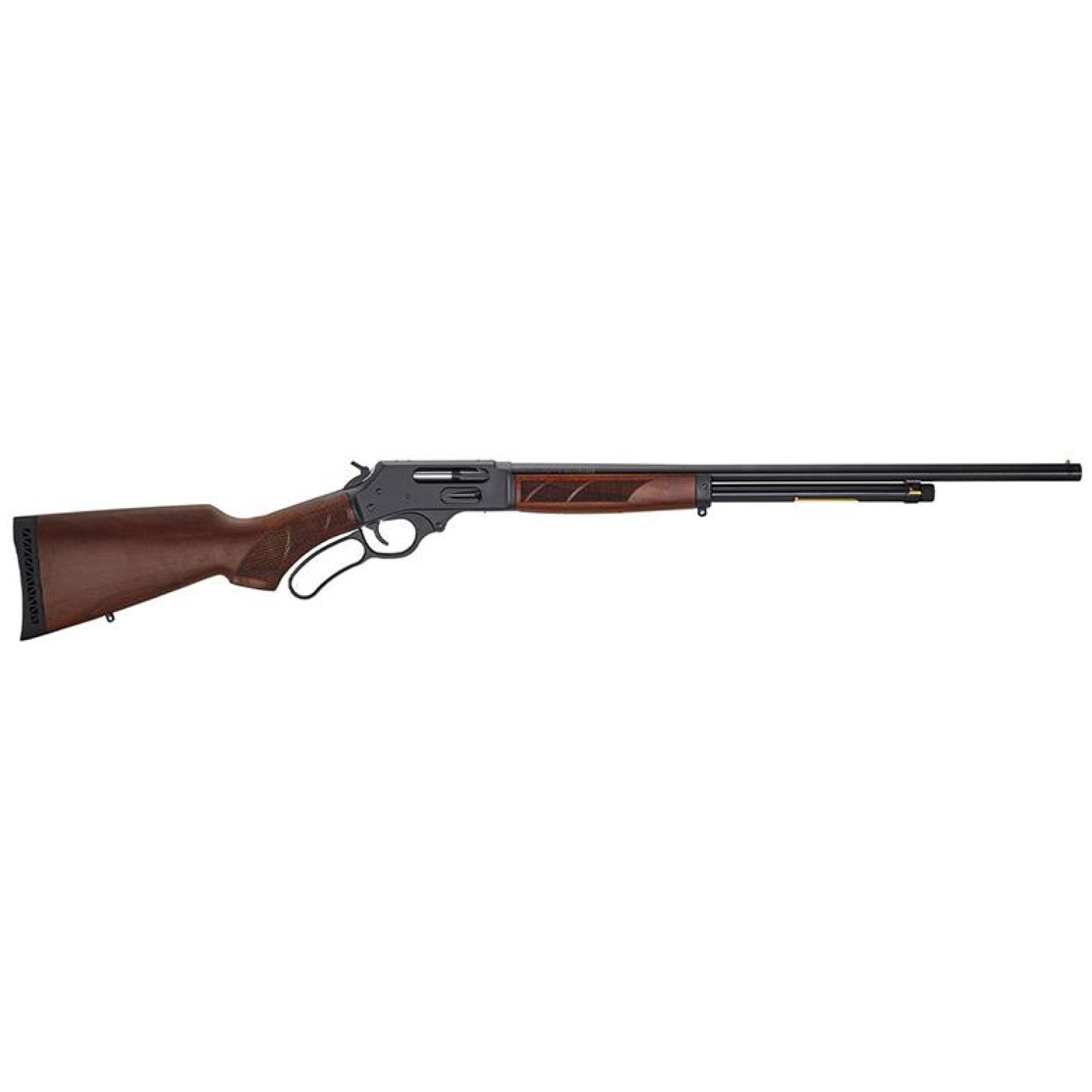
Building a brush gun or a suppressed lever? See our deep dive on the Space Cowboy Lever Action Rifle — and pair it with our Ultralight Hunting Rifles guide for mountain days.
The Most Popular Hunting Handgun Calibers
Handgun hunting is a close-range game. These four rounds carry the most field success, and each has a clear role.
.45 ACP
The softest-kicking of the four, with a heavy, large-diameter bullet that expands reliably at close range.
| Load | Bullet | Velocity | Energy | Barrel |
|---|---|---|---|---|
| Federal Premium HST (+P) | 230 gr JHP | 950 fps | 461 ft-lbs | 5″ |
| Hornady Critical Duty (+P) | 220 gr FlexLock | 975 fps | 464 ft-lbs | 5″ |
Drop (25-yd zero, 230 gr FMJ): 50 yd -2.0″ | 75 yd -6.9″ | 100 yd -15.0″.
Recoil: ~8.8 ft-lbs (calc) — a mild push, the softest of the four.
Effective range: deer and feral hog to about 50 yards with expanding loads.
Pros:
- Softest recoil of the four for fast follow-ups.
- Heavy .451-inch bullets expand reliably on medium game.
- Naturally subsonic with 230-grain loads — ideal suppressed.
Cons:
- Steep trajectory limits ethical range.
- Low retained energy past 75 yards.
- Lower velocity than the others — less margin on tough game.
Best use: close-range deer and hog with premium expanding loads, and suppressed pest control.
10mm Auto
The power-and-capacity pick. It matches or beats .357 Magnum energy from a semi-auto while holding more rounds.
| Load | Bullet | Velocity | Energy | Barrel |
|---|---|---|---|---|
| Hornady Custom XTP | 155 gr JHP | 1,265 fps | 551 ft-lbs | 4″ (likely) |
| Buffalo Bore Heavy | 200 gr FMJ | 1,200 fps | 639 ft-lbs | 4″ (likely) |
Drop (25-yd zero, 155 gr XTP, calc): 50 yd -2.8″ | 75 yd -6.3″ | 100 yd -11.2″.
Recoil: ~8.8 ft-lbs (calc) — snappy, sharper than .45 ACP, below .44 Mag.
Effective range: deer and hog to 75-100 yards with full-power hunting loads.
Pros:
- Capacity plus power — beats .357 energy from a semi-auto.
- Flat-shooting for a pistol with light, fast bullets.
- Load flexibility from reduced carry to full-power hunting.
Cons:
- Snappy recoil sharper than a .45 ACP.
- Few purpose-built hunting platforms; most data is from 4-5″ pistols.
- Premium hunting loads cost more and are thinner on shelves.
Best use: backcountry bear backup and hog or deer inside 100 yards from a full-power load.
.357 Magnum
The proven hunting revolver cartridge. Fast, flat for a handgun, and deadly on medium game from a 6-8.5″ barrel.
| Load | Bullet | Velocity | Energy | Barrel |
|---|---|---|---|---|
| Federal Fusion Bonded SP | 158 gr | 1,240 fps | 539 ft-lbs | 8.5″ test |
| Hornady American Gunner XTP | 125 gr | 1,500 fps | 624 ft-lbs | 8″ test |
Drop (50-yd zero, 158 gr, 8.5″ test): 25 yd +0.5″ | 50 yd 0 | 75 yd -2.5″ | 100 yd -7.0″.
Recoil: ~12 ft-lbs (calc, 42-oz revolver) — sharp but manageable.
Effective range: 75-100 yards ethical with premium expanding loads.
Pros:
- Flat trajectory for a handgun with light, fast bullets.
- High velocity and energy for excellent terminal performance.
- Proven hunting record with a wide bullet selection.
Cons:
- Revolver-only platform with a 6-round tube.
- About half the energy of a .44 Mag on larger game.
- Velocity-dependent terminal performance below 1,000 fps.
Best use: varmint, coyote, and medium deer at 50-100 yards from a 6-8.5″ revolver.
.44 Magnum
The benchmark big-bore hunting revolver since 1956. Devastating penetration, but the recoil is a real tax.
| Load | Bullet | Velocity | Energy | Barrel |
|---|---|---|---|---|
| Hornady Custom XTP | 240 gr | 1,350 fps | 971 ft-lbs | 7.5″ test |
| Federal Premium JSP | 240 gr | 1,270 fps | 859 ft-lbs | 4″ test |
Drop (75-yd zero, 240 gr XTP, 7.5″ test): 25 yd +0.9″ | 50 yd +1.0″ | 75 yd 0 | 100 yd -2.7″.
Recoil: ~23.5 ft-lbs (calc, 42-oz revolver) — a stout push many find punishing.
Effective range: handgun 50-75 yd ethical; lever rifle 100-150 yd.
Pros:
- The benchmark hunting revolver cartridge with decades of field success.
- Wide bullet range (165-340 gr) and dual-platform versatility.
- Excellent penetration and reliability in adverse conditions.
Cons:
- Heavy recoil limits practice volume and follow-up speed.
- Steep trajectory from a handgun; fundamentally short-range.
- Velocity-dependent terminal performance below 1,300 fps.
Best use: close-range woods hunting under 75 yards for medium deer and hog from a revolver or lever carbine.
Summary: How the Most Popular Hunting Calibers Rank
Popularity: 12 gauge first, then .223/5.56, then .308.
Versatility: 12 gauge first, then .308, then 6.5 Creedmoor.
Value: .223/5.56 first, then .308, then 12 gauge.
| Category | Top Pick | Runner-Up |
|---|---|---|
| Best long-range | .300 Win Mag | 7mm Rem Mag |
| Best big game | .30-06 | .300 Win Mag |
| Best all-around rifle | .308 Win | 6.5 Creedmoor |
| Best value | .223/5.56 | .308 Win |
| Best shotgun | 12 gauge | 20 gauge |
| Best handgun hunting | 10mm Auto | .357 Magnum |
| Best for youth | .243 Win | .410 Bore |
Common Mistakes to Avoid
- Buying a magnum you cannot practice with. Recoil you will not shoot is power you will not use.
- Ignoring state minimum-caliber and straight-wall rules. Your round has to be legal for the game you hunt.
- Trusting a flat trajectory you never confirmed. Zero your actual rifle with your actual ammo and confirm drop at your real ranges.
- Underestimating ammo cost. A cheap, shootable round that you practice with beats a premium round that stays in the box.
- Choosing a handgun round for a rifle job. Handgun hunting is a close-range discipline; respect its limits.
Final Thoughts
If you want one rifle that does everything well, start with the .308 or the 6.5 Creedmoor. If you want one shotgun, the 12 gauge has no real rival. If you want a handgun that actually hunts, the 10mm and .357 Magnum give you the best blend of power and shootability.
The best caliber is the one you can shoot accurately, that is legal for your game, and that puts a bullet where you need it at the ranges you will actually face. Match the round to the hunt, practice with the ammo you will carry, and you will be right more often than the spec sheet suggests.
Ready to Make Your Move?
Once you know your round, gear up for it. Browse rifles, shotguns, handguns, and the right ammunition for your hunt at Patriotic Firearms.
Browse the full collection at PatrioticFirearms.com →
Stay Informed
Join 10,000+ patriotic shooters who get weekly firearms news, reviews, and exclusive deals delivered straight to their inbox.
Sign Up for the Patriotic Firearms Newsletter →
No spam. Unsubscribe anytime.
Written by Nathan Grill — Firearms editor at Patriotic Firearms. Nathan covers the intersection of gun culture, Second Amendment law, and practical firearms advice for everyday American shooters.