In 2019, a handful of Midwest states told deer hunters they could no longer bring their favorite bottlenecked rifles into the woods. Rather than accept a handgun or a shotgun slug, Winchester did something clever: it engineered a brand-new cartridge from scratch to clear the legal bar while still hitting like a rifle. That cartridge is the .350 Legend, and in a few short years it has gone from a regulatory workaround to one of the most talked-about deer cartridges in America.
This guide covers everything you need to know about the .350 Legend — where it came from, its exact specifications, honest factory ballistics, the bullet types that actually exist, the platforms that chamber it, and the straight-wall legality niche that created it. We debunk the most common myth about the cartridge, separate verified data from marketing hype, and give you a straight answer on what this round does well and where it falls short.
What the .350 Legend Actually Is
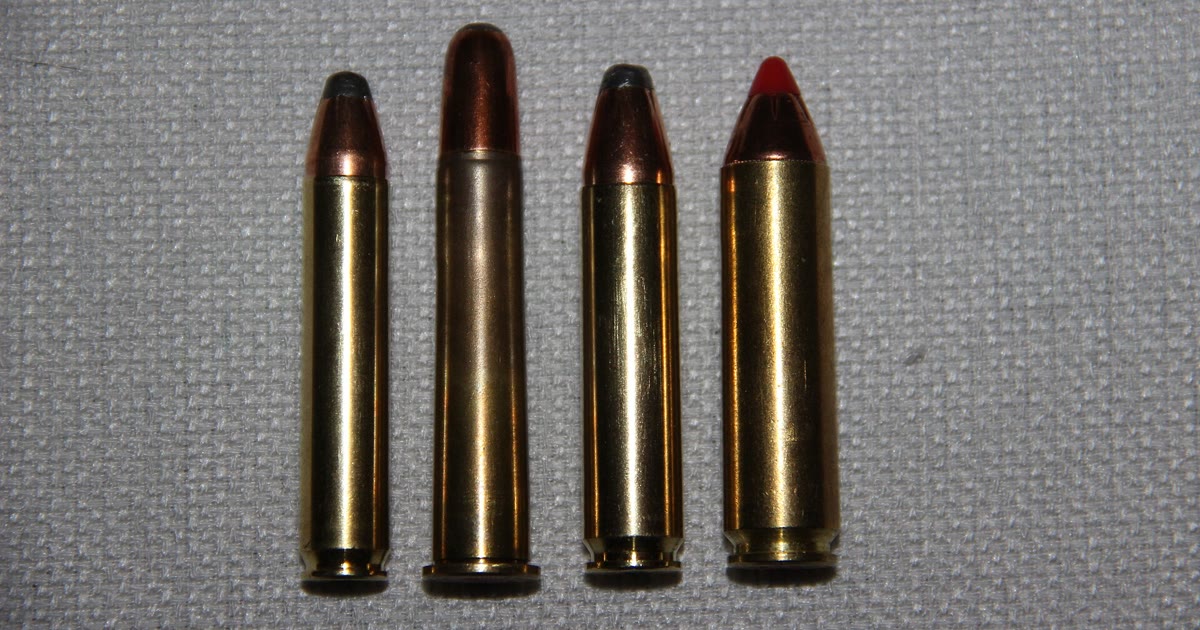
The .350 Legend is a SAAMI-standardized, straight-walled, centerfire rifle cartridge developed by Winchester and unveiled at the 2019 SHOT Show in Las Vegas. SAAMI formally accepted the cartridge and its chamber standard on January 31, 2019, and C.I.P. homologated it in Europe on April 21, 2020.
The design goal was narrow and specific: give hunters in states that restrict deer hunting to straight-wall cartridges a high-velocity, low-recoil, hard-hitting option that still fits inside the legal box. Winchester’s own FAQ describes it as “a SAAMI-approved straight-walled hunting cartridge for use in states with specific regulations for deer hunting with straight-walled centerfire cartridges.” That one sentence explains the entire existence of the round.
It is a modern, efficient, AR-friendly cartridge built around a large .357-inch bullet — and it is, by a wide margin, the best-performing straight-wall option available to hunters who are legally required to use one.
The .404 Jeffery Myth: Let’s Set the Record Straight
If you spend five minutes in any firearms forum, you will read that the .350 Legend is “based on the .404 Jeffery case.” This is false.
Winchester’s official FAQ states plainly that the cartridge “has no parent case” and that its shellcase “is a new design.” The .404 Jeffery is a large-bore African dangerous-game cartridge firing a .405-to-.411-inch bullet from a case nearly 2.89 inches long — a completely different animal from the .350 Legend’s .357-inch bullet and 1.71-inch case. The two share no practical dimensional lineage.
What the .350 Legend is: a newly engineered straight-wall, rebated-rim case that deliberately borrows the .223 Remington nominal rim diameter (.378 inch) so it can run in a standard AR-15 bolt face. It was not adapted from the .223 case either — the rim diameter was chosen for compatibility, not because of parentage. The body carries a slight taper to aid extraction from a straight-walled geometry.
So when someone tells you the .350 Legend is a necked-down .404 Jeffery, you can now tell them the manufacturer says otherwise. It is its own cartridge.
Specifications
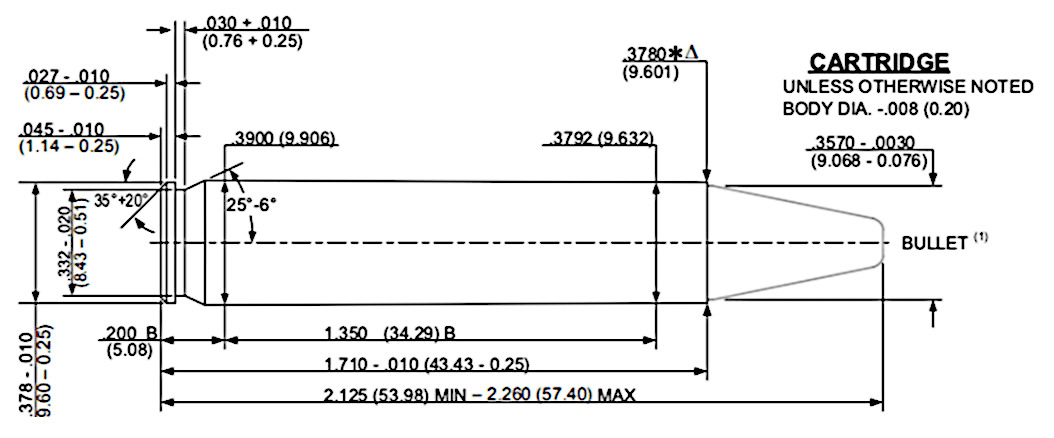
The .350 Legend is standardized by both SAAMI (US) and C.I.P. (Europe). Their tables use different datum labels, so a few values are not directly comparable, but the core dimensions are confirmed against primary sources.
| Dimension | SAAMI (in) | C.I.P. (mm) | Notes |
|---|---|---|---|
| Bullet diameter | .3570 (−.0030 tol) | 9.07 | Despite the “350” name, the bullet is .357 inch |
| Rim diameter | .378 | 9.60 | Same nominal rim as .223 Remington |
| Base / body diameter | .390 | 8.43 (datum-specific) | Slight taper for extraction |
| Case length | 1.71 | 43.43 | Straight-wall |
| Max overall length (COAL) | 2.260 | 57.40 | Identical to .223 Remington |
| Case capacity | ~36.5 gr H₂O | — | Nominal measured property, not a controlled spec |
| Primer | Small Rifle | — | Standard small rifle primer |
Pressure standards. The SAAMI Maximum Average Pressure (MAP) is 55,000 psi, measured by piezoelectric transducer. C.I.P. lists a service pressure (Pmax) of 4,300 bar (≈ 62,400 psi) and a proof pressure of 4,945 bar. One important caveat: these two numbers are not directly comparable. SAAMI MAP is an average across multiple shots; C.I.P. Pmax is a single-shot maximum, and the two use different measurement methods and pressure-take locations. The C.I.P. figure being numerically higher does not mean C.I.P.-loaded ammo is “hotter” in any safety sense.
Designations. Primary name: .350 Legend. Alternate: 350 LGND. Metric notation: 9×43mmRB. C.I.P. homologation name: “350 Legend” (country of origin US).
Interchangeability warning. Despite sharing a ~.357-inch bullet diameter with the .357 Magnum revolver cartridge and the bottlenecked .35 Remington, the .350 Legend is a distinct SAAMI-standardized cartridge with its own chamber dimensions and is NOT interchangeable with either. Similar bullet diameter never implies interchangeability — case dimensions, headspace datum, pressure, and chamber geometry all differ. Never chamber or fire a cartridge not explicitly marked for your firearm.
The AR-15 Bolt Face: The Most Misstated Fact
Here is the single most frequently gotten-wrong fact about the .350 Legend, and the manufacturer source is unambiguous: the .350 Legend uses a standard .223/5.56 bolt face (.378 inch). No dedicated larger bolt face is required.
CMMG, a manufacturer that builds .350 Legend ARs, states the cartridge uses a “.378″ bolt face, so it uses a standard .223/5.56 bolt,” and that a shooter “could purchase a .350 Legend AR rifle, or use a .350 Legend AR upper.” The .378-inch rim diameter was chosen precisely so the round feeds from a standard AR-15 bolt face. Multiple AR-component vendors list combined .223 / .300 BLK / .350 Legend bolt carrier groups, consistent with a shared face.
The magazine caveat, though, is real. Although the bolt face is standard, Winchester’s FAQ notes the .350 Legend “is not compatible with standard .223 Rem/5.56mm magazines” because the straight-walled case geometry differs. You need dedicated .350 Legend magazines. So: standard bolt, special mags. Remember that and you’ll save yourself a frustrating trip to the range.
Factory Ballistics: The Honest Numbers
The .350 Legend factory ammunition spans a bullet weight range of 145 to 180 grains for supersonic hunting loads. All velocity figures below are from a 20-inch test barrel unless otherwise noted.
| Manufacturer | Load | Weight | Type | Muzzle Vel (fps) | Muzzle Energy (ft-lb) | G1 BC |
|---|---|---|---|---|---|---|
| Winchester | USA FMJ | 145 gr | Full Metal Jacket | 2,350 | 1,778 | ~0.186 |
| Winchester | Deer Season XP | 150 gr | Extreme Point | 2,325 | 1,800 | ~0.226 |
| Federal | Fusion | 160 gr | Bonded Soft Point | 2,300 | 1,880 | ~0.264 |
| Winchester | Power Max Bonded | 160 gr | Bonded PHP | 2,225 | 1,759 | ~0.206 |
| Hornady | Custom FTX | 165 gr | FTX Soft Point | 2,200 | 1,777 | ~0.219 |
| Hornady | American Whitetail | 170 gr | InterLock SP | 2,200 | 1,827 | ~0.219 |
| Barnes | VOR-TX | 170 gr | TSX Solid Copper | ~2,200 | 1,704 | ~0.220 |
| Winchester | Super-X Power-Point | 180 gr | Soft Lead Alloy | 2,100 | 1,762 | ~0.225 |
| Federal | Power-Shok | 180 gr | Soft Point | 2,100 | 1,762 | 0.245 |
Energy Reality Check
Marketing materials and some online sources have inflated the .350 Legend’s energy figures. Let’s establish the honest reality: the verified factory muzzle-energy band is 1,700 to 1,880 ft-lb. The highest verified factory muzzle energy belongs to the Federal Fusion 160-grain at 1,880 ft-lb from a 20-inch barrel, followed by the Hornady 170-grain American Whitetail at 1,827 ft-lb and the Winchester Deer Season XP 150-grain at 1,800 ft-lb.
Claims of 2,000+ ft-lb are not supported by any manufacturer-published data. The cartridge’s case capacity (~36.5 grains of water) and operating pressure limits simply constrain its output. For context, the .350 Legend’s top-end energy is comparable to a .30-30 Winchester (~1,838 ft-lb with 150gr) but significantly less than a .243 Winchester (~2,000+ ft-lb) or .308 Winchester (~2,400 ft-lb). This is a moderate-energy cartridge suited to close-to-moderate ranges, not a long-range powerhouse.
Trajectory
Using the Winchester Deer Season XP 150-grain load zeroed at 100 yards, the trajectory profile looks like this:
| Range (yd) | Drop (in) | Notes |
|---|---|---|
| 50 | +1.5 | Slightly above point of aim |
| 100 | 0 | Zero range |
| 150 | −3.8 | Moderate hold-under required |
| 200 | −7.6 | Significant hold-under needed |
The .350 Legend is a close-to-moderate-range cartridge. Beyond 150 yards the trajectory becomes steep enough that precise range estimation becomes critical. At 200 yards the bullet drops nearly 8 inches below the line of sight, requiring significant hold-under or turret adjustment.
Energy Retention
Energy retention is the number that actually matters for terminal performance. Here is how the .350 Legend’s factory loads hold up downrange:
| Load | Muzzle (ft-lb) | @ 100 yd | % @ 100 | @ 200 yd | % @ 200 |
|---|---|---|---|---|---|
| Winchester 145gr FMJ | 1,778 | 1,182 | 66.5% | 763 | 42.9% |
| Winchester 150gr XP | 1,800 | 1,289 | 71.6% | 903 | 50.2% |
| Federal Fusion 160gr | 1,880 | 1,418 | 75.4% | 1,054 | 56.1% |
| Hornady 170gr InterLock | 1,827 | 1,281 | 70.1% | 882 | 48.3% |
| Winchester 180gr SP | 1,762 | 1,240 | 70.4% | 859 | 48.8% |
The .350 Legend retains roughly 50% of its muzzle energy at 200 yards. The 1,000 ft-lb threshold — a commonly cited minimum for clean deer harvests — is crossed at approximately 125 to 150 yards depending on the load. The Federal Fusion 160-grain holds above 1,000 ft-lb the longest; the lighter 145-grain FMJ drops below it before 125 yards. This is the single most important number for a hunter to internalize: beyond roughly 150 yards, the .350 Legend is operating below the energy level most experts consider adequate for a clean, ethical harvest on deer-sized game.
Recoil
Manufacturers rarely publish recoil figures for the .350 Legend, so the values below are computed estimates (7-pound rifle, powder-gas momentum included) rather than manufacturer-verified numbers. That said, they line up with field experience: the .350 Legend runs roughly 5.5 to 6.5 ft-lb of recoil energy — noticeably lighter than the .450 Bushmaster (~10-12 ft-lb) it competes with in straight-wall states, and comparable to or slightly lighter than the .30-30 (~8-9 ft-lb) and .243 (~7-8 ft-lb). It is one of the softest-recoiling centerfire hunting cartridges available, a genuine advantage for recoil-sensitive hunters, youth shooters, and AR-platform users.
Bullet Types: What Actually Exists
One important correction up front: the 145-grain .350 Legend that exists is a full-metal-jacket target load, not a varmint or predator hunting bullet. An FMJ truncated cone is the wrong construction for small-game dispatch. The genuine hunting weights cluster at 150, 165, 170, and 180 grains, with a 160-grain AR-oriented load and a 255-grain subsonic in the mix.
- 145 gr — target, not varmint. Winchester’s 145-grain USA White Box is an FMJ “truncated cone target bullet for high accuracy in range training.” Cheap, accurate, low-recoil — great for practice, wrong for hunting.
- 150 gr — fast-expanding deer. The Deer Season XP uses Winchester’s Extreme Point polymer tip with an “oversized impact diameter for larger wound cavities and faster knockdown.” The fastest, most explosive deer bullet in the lineup and the one most straight-wall whitetail hunters reach for inside 100 yards.
- 160 gr — AR-15 oriented. Winchester’s 160-grain Defender is “designed for the AR-15 platform.” (Exact jacket construction is not specified by the manufacturer.)
- 165 gr — tipped deer. Hornady’s 165-grain FTX American Whitetail TIPPED uses a polymer tip with a secant ogive and the InterLock ring for a flatter trajectory and reliable expansion.
- 170 gr — classic soft-point deer. Hornady’s 170-grain InterLock American Whitetail is a lead-core InterLock bullet; the ring mechanically locks jacket and core to limit separation on impact — a proven whitetail design.
- 180 gr — heavier deer/hog. Winchester’s Power-Point (alloyed-core soft point with strategic notching) and Federal’s Power-Shok 180-grain soft point are the sensible choices for larger deer and hogs.
- Bonded and subsonic. Winchester’s Power Max Bonded (X3501BP) offers a bonded core for deeper penetration and weight retention. The 255-grain Super Suppressed is a subsonic open-tip range bullet at ~1,060 fps for suppressed use — not a hunting projectile.
A note on the Federal Fusion .350 Legend: a secondary ballistics aggregator lists a 160-grain Fusion load at 1,879 ft-lb, but Federal’s own Fusion product page did not confirm a .350 Legend Fusion load when checked. Because the only support is a secondary source, treat this product as unverified until a Federal product page confirms it.
Hunting Applications

Whitetail deer — the primary target. The .350 Legend was, in Winchester’s words, “engineered for deer hunters to deliver massive downrange energy transfer with improved penetration from a modern straight-[walled cartridge].” In practice the 150-grain Deer Season XP and the 165/170-grain Hornady loads are the whitetail workhorses, and the cartridge is most at home inside 150 yards where its energy and expansion are fully deployed. The large .357-inch frontal diameter creates a wide wound channel even with moderate expansion — a .357-inch bullet that expands to .60-.70 inches is devastating on deer.
Feral hogs. The heavier 180-grain soft points and the bonded Power Max variant are the sensible hog choices because they retain weight and penetrate. Honest caveat: hogs are tough, shoulder-heavy animals, and the .350 Legend’s energy ceiling means shot placement matters more than with a bottlenecked round. It is a capable hog cartridge at close range (under 100 yards) with proper placement, not a brush-buster for running pigs at distance. For larger hogs or dense brush, solid or hard-cast bullets beat soft points.
What it is NOT good for. Long-range shooting (trajectory and energy fall off quickly past 150 yards), large dangerous game (elk, moose, bears at range — the energy and penetration are marginal and the ethical margin is thin), and small varmint control (the FMJ 145-grain is a target bullet, and the expanding hunting bullets are overkill and poor for tiny animals).
The Straight-Wall Legality Niche
This is the reason the cartridge exists. Several Midwest big-deer states restrict deer hunting with rifles to straight-wall cartridges, and the .350 Legend was purpose-built to clear that bar with the best possible ballistics. Here is the verified state-by-state picture — and note that legal minimums are the legal floor, not an ethical recommendation on shot placement or terminal performance.
- Ohio — legal. Ohio DNR allows “all straight-walled cartridge calibers from a minimum of .357 to a maximum of .50,” and the .350 Legend was specifically included after Winchester’s SAAMI submission described the caliber as “.357 − 0.0030.”
- Iowa — legal. Iowa requires a bullet diameter of at least .350 inch and no larger than .500 inch with at least 500 ft-lb muzzle energy. The .350 Legend clears these limits comfortably. (Iowa no longer mandates case shape.)
- Illinois — legal with a platform caveat. Illinois allows straight-walled cartridges with a pistol or a single-shot rifle; single-shot rifles in qualifying calibers became legal January 1, 2023. The platform restriction matters here, not just the cartridge.
- Michigan — legal (former shotgun zone). Michigan’s Wildlife Conservation Order permits “.35 caliber or larger rifle loaded with straight-walled cartridges” with a case length between 1.16 and 1.80 inches, explicitly naming the .350 Legend. Note: recent reports indicate Michigan’s rifle-line restrictions were relaxed for the 2026 season; confirm against the current-year Michigan DNR regulations before relying on the regional rule.
- Indiana — legal, but the rule changed. Indiana’s long-standing straight-wall-only public-land rule was replaced for the 2025-26 season by a broader rule allowing centerfire rifles of .219 inch (5.56 mm) or larger on both public and private land. The .350 Legend remains legal; it simply is no longer required to be straight-wall there.
A few additional states and provinces have straight-wall or caliber-based deer rules. Always confirm against the current-year agency regulation before hunting — these rules change.
Rifle Platforms
The .350 Legend was designed to cycle in a variety of platforms:
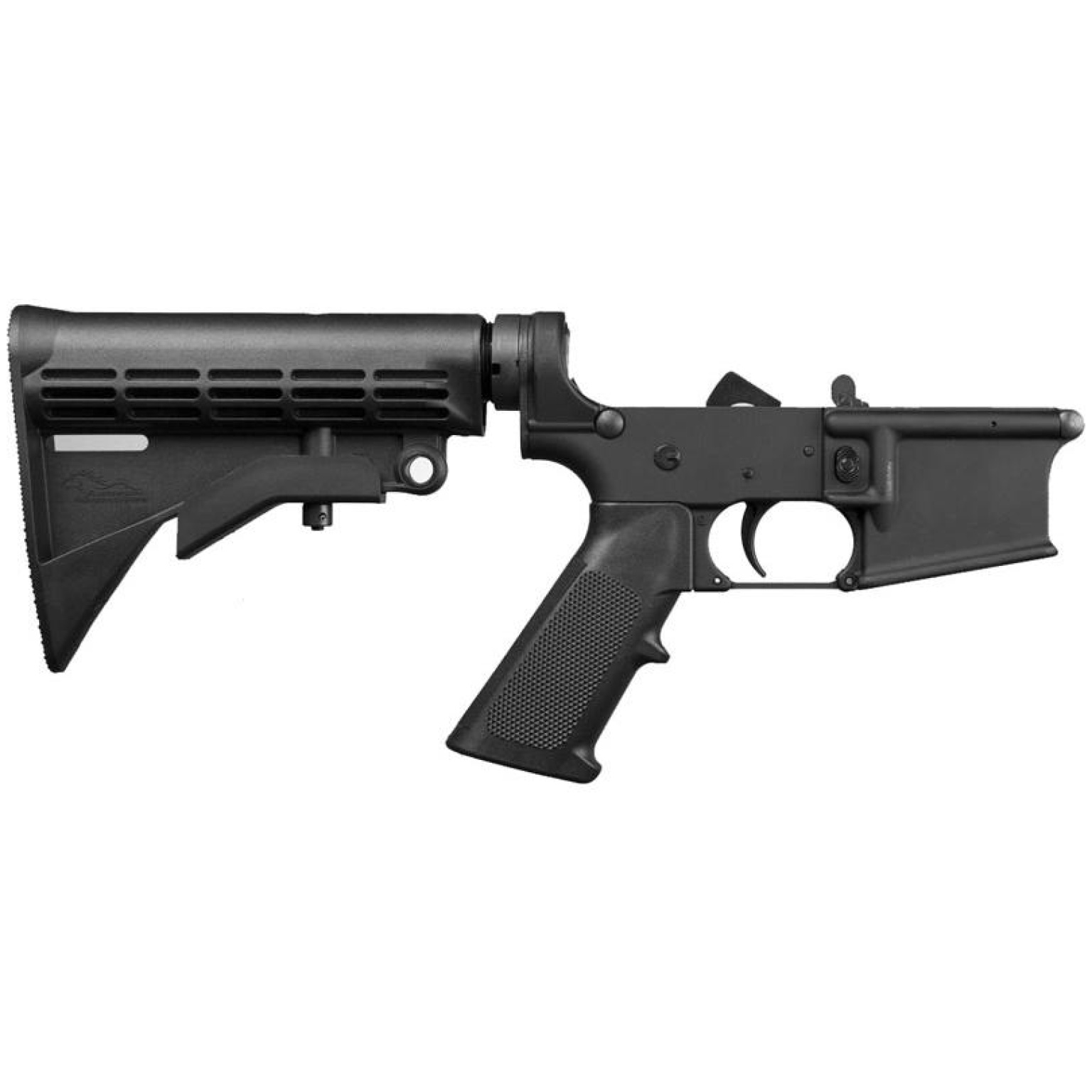
- AR-15: chamberings exist and use the standard .223/5.56 bolt face (with dedicated .350 Legend magazines). The 160-grain Defender is explicitly AR-oriented.
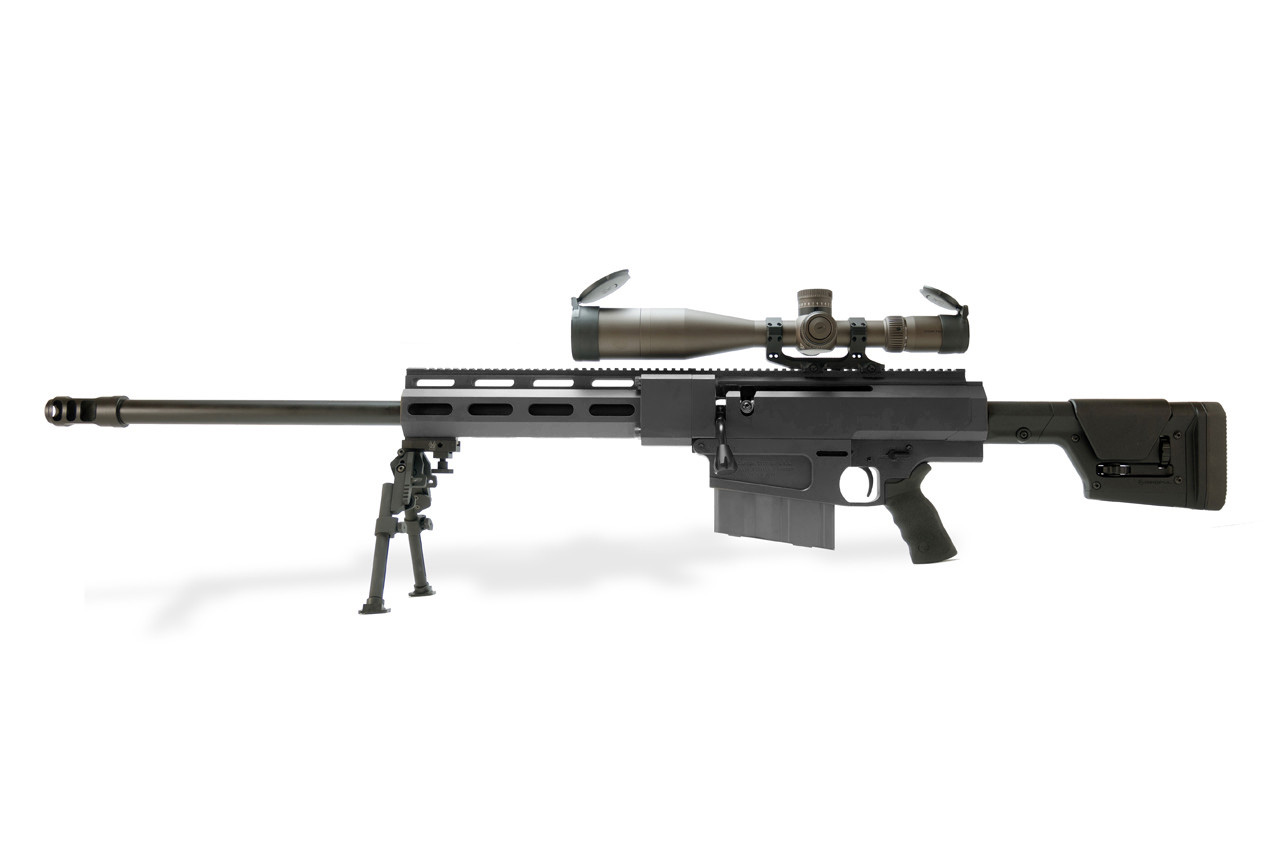
- Bolt-action: the cartridge operates in bolt-action rifles such as the Winchester XPR.
- Single-shot: a common and legal platform category for straight-wall hunting, with single-shot .350 Legend rifles widely available.
- Lever-action: as of this writing, lever-action .350 Legend availability is unverified against a primary manufacturer source — do not assume one exists without confirmation.
Ammunition Market & Availability
The .350 Legend is produced by the major U.S. manufacturers — Winchester (the originator), Hornady, and Federal — across multiple product lines, which is itself a signal of a healthy, mainstream cartridge rather than a niche experiment. It sits in the mid-price class for centerfire rifle ammo: cheaper per round than premium bottlenecked deer cartridges but more expensive than bulk .223, with the 145-grain FMJ as the value/target option and the bonded/premium lines at the top of the band. Availability has been good since launch because the cartridge was designed around an existing, popular legal niche rather than a speculative one.
Pros and Cons
Pros
- Legal in the major straight-wall deer states (Ohio, Iowa, Michigan, Illinois with platform caveats, Indiana)
- Fast for a straight-wall cartridge — Winchester markets it as the fastest SAAMI-approved straight-walled hunting cartridge
- Low recoil, easy to shoot accurately, friendly to youth and small-framed hunters
- Hard-hitting on deer inside 150 yards with proven bullet designs (Deer Season XP, InterLock, FTX)
- Cycles in AR-15, bolt-action, and single-shot platforms
- Wide factory support from three major manufacturers
Cons
- Energy ceiling is modest (~1,700-1,880 ft-lb factory) versus bottlenecked rounds that exceed 2,500-3,500 ft-lb
- Trajectory and retained energy drop off quickly past 150 yards
- Not suitable for large dangerous game or long-range shooting
- Straight-wall case = less case capacity, so velocity is limited by physics, not just tuning
- Requires dedicated magazines in the AR platform
Recommendations by Use Case
| Use case | Recommended load | Why |
|---|---|---|
| Whitetail in a straight-wall state (under 100 yd) | 150 gr Deer Season XP or 165 gr FTX | Fast, explosive expansion, flatter trajectory |
| Whitetail, larger deer / 100-150 yd | 170 gr InterLock or 180 gr Power-Point | Heavier bullet, better penetration and weight retention |
| Feral hogs (close, well-placed) | 180 gr Power-Point / Power-Shok or Power Max Bonded | Penetration and weight retention on tough animals |
| AR-15 platform hunting | 160 gr Defender | Designed for AR function |
| Target / practice / youth | 145 gr USA White Box FMJ | Cheap, accurate, low recoil |
| Suppressed plinking | 255 gr Super Suppressed | Subsonic, suppressor-friendly |
| Long-range (>200 yd) | Not recommended | Energy and trajectory inadequate |
| Large dangerous game / elk / moose | Not recommended | Marginal energy and penetration |
The Verdict
The .350 Legend is a capable, honest cartridge for a specific purpose. Its verified factory muzzle-energy band of 1,700-1,880 ft-lb, roughly 50% energy retention at 200 yards, and genuinely low recoil make it an excellent choice for hunters in straight-wall states who hunt at 100-150 yards or less. Its strengths are real: low recoil, a large-caliber wound channel, reliable bullet expansion, and AR-platform compatibility on a standard bolt face. Its limitations are equally real: a steep trajectory beyond 150 yards, sub-1,000 ft-lb energy past 125-150 yards, and no manufacturer accuracy guarantee.
If you hunt in a straight-wall state and your typical shot distances are under 150 yards, the .350 Legend is a genuinely effective, well-designed cartridge that delivers on its promises — and it is the best tool the law allows you. If you need to reach out to 200+ yards, choose a bottlenecked cartridge instead. The .350 Legend does exactly what it was designed to do, and it does it well. Pretending it is a long-range performer does the cartridge a disservice.
For the hunter who lives inside the straight-wall box and shoots deer at reasonable ranges, it is a genuinely excellent tool. For the hunter who wants one rifle for everything, it is the wrong compromise. Know which one you are, and the .350 Legend will serve you well.
Ready to gear up for straight-wall season? Browse the full selection of .350 Legend rifles, AR uppers, and factory ammunition at Patriotic Firearms — and stock up on the dedicated magazines you’ll need for your AR build.
Stay in the loop. Get new caliber guides, ballistics deep-dives, and gear reviews delivered straight to your inbox. Subscribe to the Patriotic Firearms newsletter — no spam, just honest firearms content from people who actually shoot.
About the author: Nathan Grill is a lifelong firearms enthusiast and writer covering cartridges, ballistics, and hunting gear for Patriotic Firearms. He believes in honest data over marketing hype and in the Second Amendment rights of law-abiding Americans.
Disclaimer: This article is for informational and educational purposes only. Ballistic figures are drawn from manufacturer-published data and reputable references and may vary by rifle, barrel length, and conditions. Hunting regulations vary by state and change frequently — always verify current-year regulations with your state wildlife agency before hunting. This article is not legal advice. Always follow all federal, state, and local laws and practice safe firearm handling.