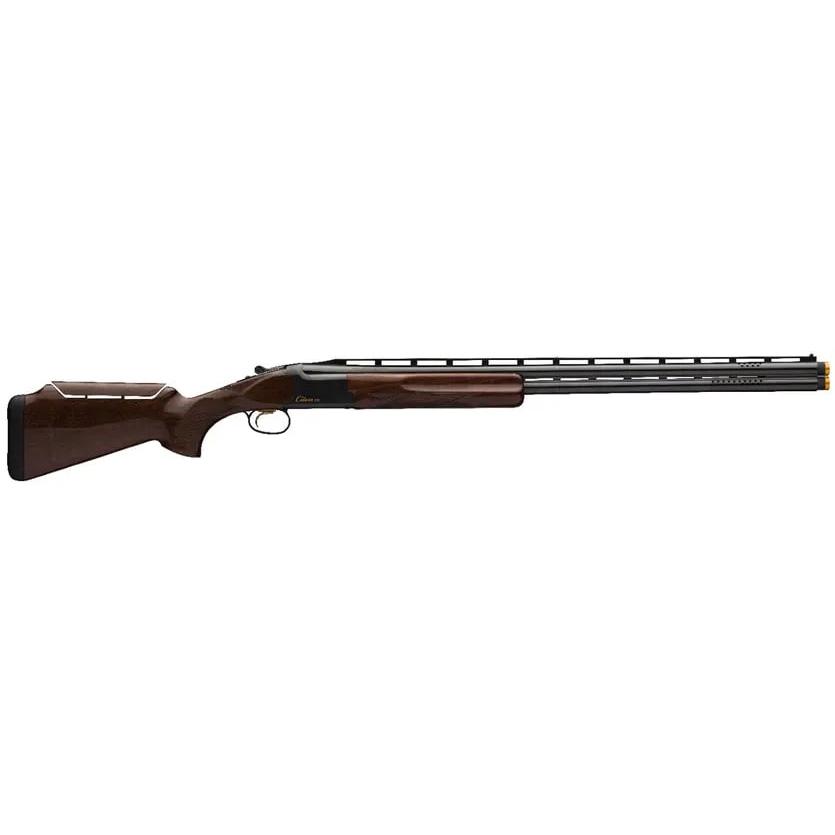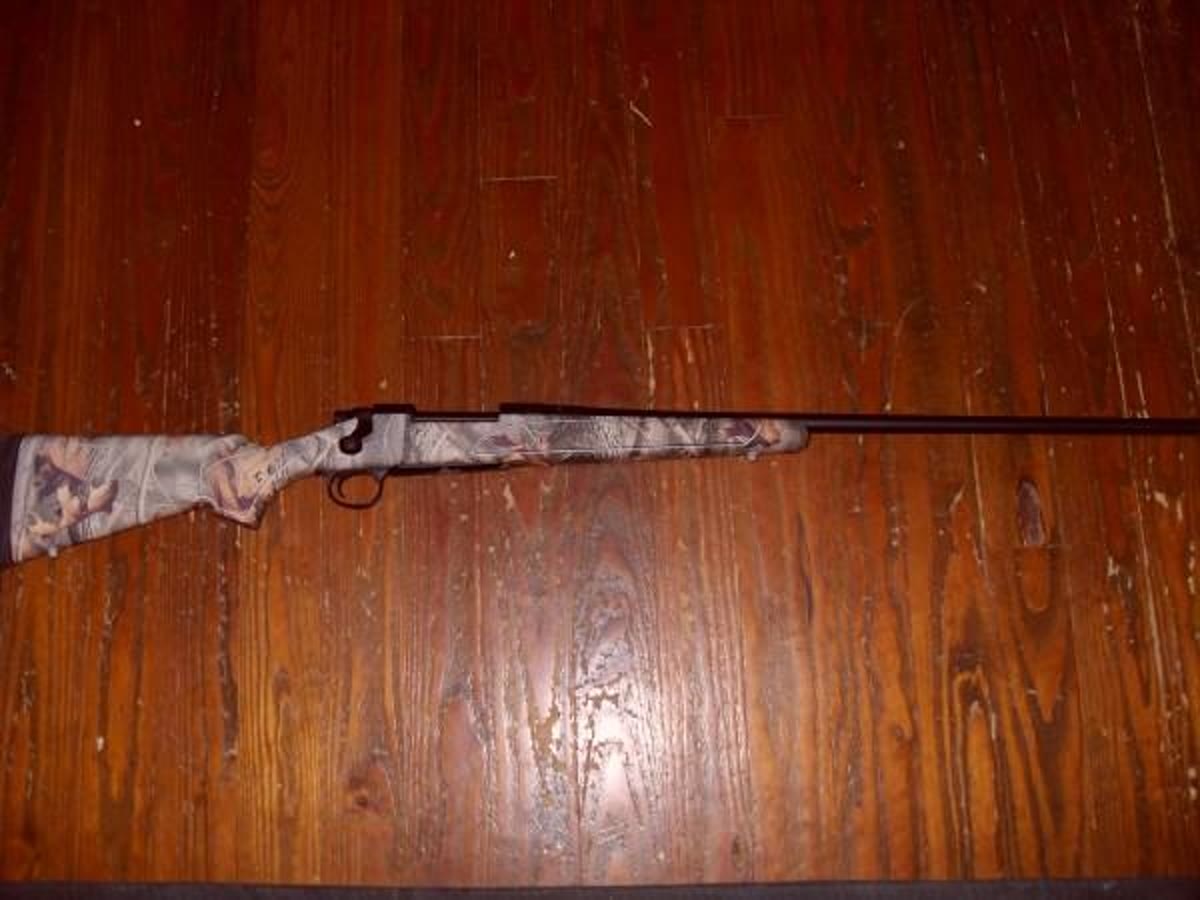
For nearly a century, one cartridge has stood as the definition of the American big-game rifle round: the .270 Winchester. Flat-shooting, hard-hitting, and light enough to carry all day over ridgelines, it built the reputation of the modern hunting rifle and gave generations of hunters a cartridge that could reach out and ethically drop deer and elk at distances that once seemed impossible.
But the .270 is also one of the most misunderstood rounds in the rack. People get its parent case wrong, its name wrong, and its limits wrong. This guide sets the record straight with verified specs, honest ballistics, and a no-nonsense look at what the .270 actually does — and where it doesn’t.
Origin & History: Born to Reach Out
The .270 Winchester was developed by the Winchester Repeating Arms Company in 1923 and unveiled in 1925 as a chambering for the bolt-action Winchester Model 54. At launch it carried a different name: “270 WCF” — 270 Winchester Centerfire.
Winchester built it with a single job in mind: a flat-trajectory, high-velocity big-game cartridge for medium to large game at 300–500 yards. In an era when most hunting rounds dropped like a stone past 200 yards, the .270’s flat curve was a genuine breakthrough. It was compared favorably with the .300 Holland & Holland Magnum and was arguably the flattest-shooting cartridge available at the time of its release.
The Parent-Case Correction
Here is the mistake almost everyone makes. The .270 Winchester is not a necked-down .30-06 Springfield. It is a necked-down .30-03 Springfield, and it keeps that parent’s slightly longer neck — which is part of why the .270 feeds and performs the way it does. The .30-06 itself also descends from the .30-03, which makes the .270 and the .30-06 siblings, not parent and child.
You can form a .270 case from a .30-06 because the two are closely related, but the true lineage runs through the .30-03. That longer neck is a real engineering feature, not a footnote.
Jack O’Connor: The Promoter, Not the Designer
The .270’s fame is inseparable from Jack O’Connor, the legendary gun writer who bought a Winchester Model 54 in .270 the first year it was available and championed the cartridge for roughly 40 years in Outdoor Life magazine. His elk-hunting stories and relentless advocacy made the .270 a cultural touchstone of mid-century American hunting.
One honest note: no individual Winchester designer or engineer has been confirmed in the primary sources reviewed as the cartridge’s creator. It is credited to Winchester as a company. O’Connor was the promoter, not the designer — a distinction worth keeping straight.
What the Name Actually Means
The number “270” refers to the nominal bore (land) diameter — the .270-inch groove-to-groove measurement. The actual bullet diameter is .277 inches (7.04 mm).
That mismatch trips people up constantly:
- .270 = the bore diameter, used in the cartridge’s name
- .277 = the bullet diameter, used when you buy bullets and size dies
Both describe the same cartridge. When you shop for .270 Winchester bullets, you’re buying .277 caliber projectiles.
The WSM Confusion (and the Myth That Isn’t)
There is no recognized cartridge called “.270 Win Short Action.” That name is a confusion with the .270 WSM — the Winchester Short Magnum, introduced in 2002 on a short-action platform.
| Feature | .270 Winchester | .270 WSM |
|---|---|---|
| Action length | Standard / long | Short |
| Parent case | .30-03 Springfield | .404 Jeffery (short-magnum family) |
| Introduced | 1925 | 2002 |
| 130gr velocity | ~3,060 ft/s | ~3,260 ft/s |
| Case capacity | ~67 gr H₂O | ~75 gr H₂O |
The WSM throws the same bullet roughly 200 feet per second faster from a shorter, fatter case. They are different cartridges, not a long/short pair of the same one.
Specifications: The Numbers
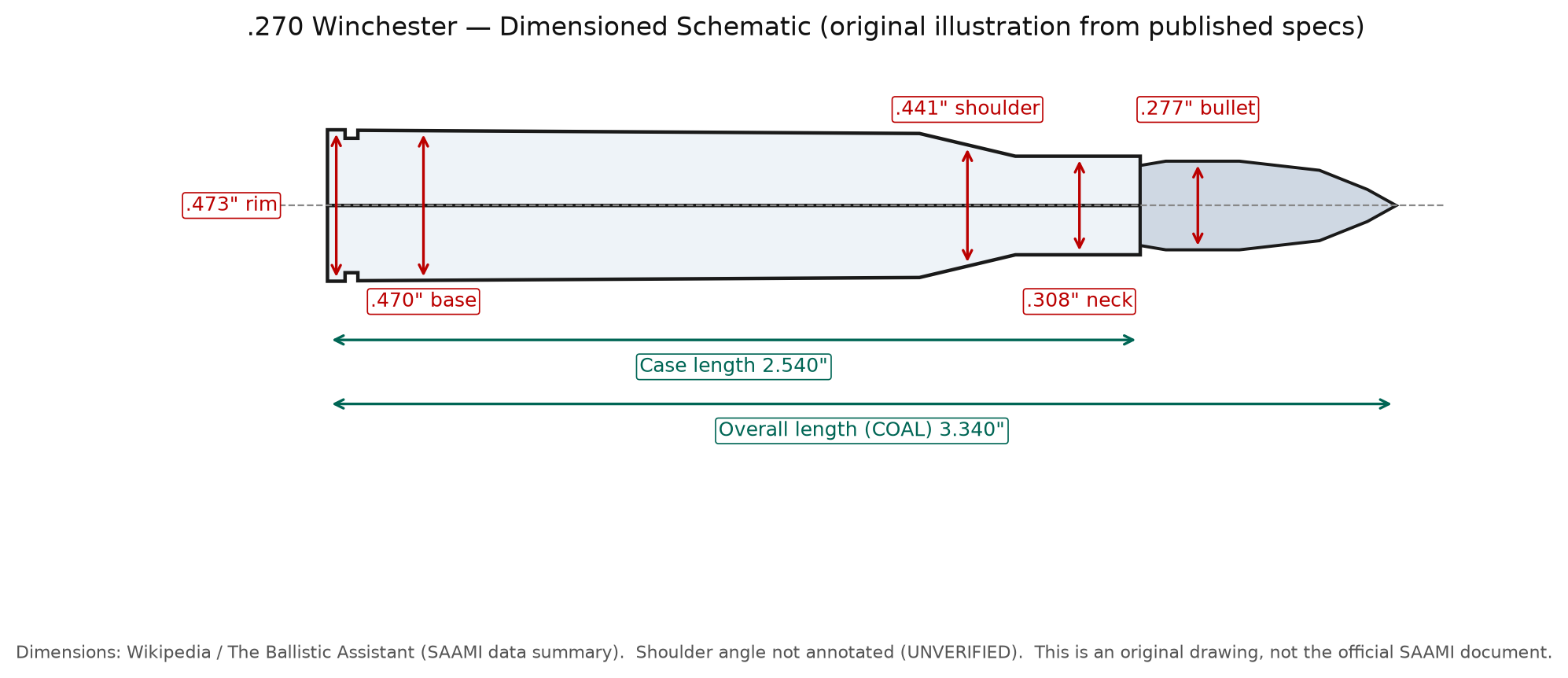
All figures below are drawn from SAAMI/CIP-sourced references and factory data. Items that could not be confirmed against a primary source are marked UNVERIFIED.
| Specification | Value | Status |
|---|---|---|
| Case length | 2.540 in (64.5 mm) | Confirmed |
| Trim-to length | 2.520 in (64.0 mm) | Confirmed |
| Base diameter | .470 in (11.9 mm) | Confirmed |
| Shoulder diameter | .441 in (11.2 mm) | Confirmed |
| Neck diameter | .308 in (7.8 mm) | Confirmed |
| Rim diameter | .473 in (12.0 mm) | Confirmed |
| Overall length (COAL) | 3.340 in (84.8 mm) | Confirmed |
| Bullet diameter | .277 in (7.04 mm) | Confirmed |
| Rifling twist | 1:10 in (250 mm) | Confirmed |
| Case capacity | 67 gr H₂O (4.3 cm³) | Confirmed |
| SAAMI max pressure (MAP) | 65,000 psi / 52,000 CUP | Confirmed |
| CIP max pressure | 4,300 bar (≈62,366 psi) | Confirmed |
| Action length | Standard / long | Confirmed |
| Shoulder angle / chamber datum | — | UNVERIFIED |
The .270 runs at a standard full-rifle pressure — 65,000 psi SAAMI — and is a long-action cartridge. That long action is why it won’t fit a short-action rifle, and why the WSM exists as the short-action answer.
Ballistics: Velocity, Trajectory, and What’s Real
The Iconic 130-Grain Figure
The .270 was originally loaded in 1925 to drive a 130-grain spitzer at about 3,140 ft/s. Modern factory loads have dialed that back to 3,060 ft/s — still blazing for a standard-action cartridge.
Modern Factory Loads
| Bullet | Product | Muzzle Velocity | Muzzle Energy | G1 BC |
|---|---|---|---|---|
| 130 gr | Federal Power-Shok 270A | 3,060 fps | 2,702 ft-lb | 0.372 |
| 130 gr | Hornady Superformance SST | 3,200 fps | 2,955 ft-lb | 0.460 |
| 140 gr | Hornady InterLock BTSP | 2,940 fps | 2,687 ft-lb | 0.473 |
| 140 gr | Hornady SST Superformance | 3,090 fps | 2,968 ft-lb | 0.495 |
| 150 gr | Federal Fusion | 2,850 fps | 2,705 ft-lb | 0.495 |
| 150 gr | Hornady InterLock SP | 2,840 fps | 2,685 ft-lb | 0.486 |
| 160 gr | Double Tap Nosler Partition | 2,850 fps | 2,887 ft-lb | UNVERIFIED |
Honest note on the 160gr BC: No G1 ballistic coefficient was published for the only factory 160gr load found. A 0.389 BC that circulates online belongs to a .284 (7mm) bullet, not a .277 — it must not be applied to the .270. Treat the 160gr BC as UNVERIFIED.
Trajectory (COMPUTED — not a manufacturer drop table)
The following are computed estimates using a G1 numerical integrator: 100-yard zero, 1.5-inch sight height, sea-level standard atmosphere, 10 mph full-value crosswind. True these to your own rifle and chronograph before relying on them in the field.
130 gr Power-Point (3,060 fps, G1 0.372):
| Range | Velocity | Energy | Drop | Energy Retained |
|---|---|---|---|---|
| 100 yd | 2,881 fps | 2,396 ft-lb | 0.0 in | 88.7% |
| 200 yd | 2,704 fps | 2,110 ft-lb | −8.2 in | 78.1% |
| 300 yd | 2,529 fps | 1,845 ft-lb | −19.2 in | 68.3% |
| 400 yd | 2,355 fps | 1,600 ft-lb | −35.7 in | 59.2% |
| 500 yd | 2,183 fps | 1,375 ft-lb | −58.6 in | 50.9% |
150 gr Federal Fusion (2,850 fps, G1 0.495):
| Range | Velocity | Energy | Drop | Energy Retained |
|---|---|---|---|---|
| 100 yd | 2,717 fps | 2,459 ft-lb | 0.0 in | 90.9% |
| 200 yd | 2,585 fps | 2,225 ft-lb | −9.3 in | 82.3% |
| 300 yd | 2,454 fps | 2,005 ft-lb | −21.5 in | 74.1% |
| 400 yd | 2,323 fps | 1,797 ft-lb | −39.7 in | 66.4% |
| 500 yd | 2,194 fps | 1,603 ft-lb | −64.3 in | 59.3% |
Calibration honesty: A cross-check against a published chart for the same 130gr Power-Shok load gave −26.1 in at 300 yd and −48.8 in at 500 yd. The solver here under-drags at 300 and over-drags at 500, which is normal G1-model variance for a spitzer. Use these as a planning baseline, not gospel.
How It Stacks Against the .30-06 and 6.5 Creedmoor
- Vs .30-06: The .270 130gr runs about 150 fps faster at the muzzle but carries about 118 ft-lb less energy than a .30-06 150gr load — and it shoots flatter (−18.0 in vs −20.5 in at 400 yd). The .270 trades punch for a flatter curve and lighter recoil.
- Vs 6.5 Creedmoor: The .270 delivers more muzzle velocity and more muzzle energy than a 6.5 Creedmoor, and its .277 bullet makes a wider wound channel than a .264. But the 6.5’s higher BC (≈0.625 vs ≈0.536 for the .270’s best hunting bullet) means the 6.5 closes and eventually passes the .270’s trajectory past roughly 600 yards.
Bullet Types: Match the Bullet, Not Just the Caliber
The .270 is not one cartridge with one behavior. Its terminal performance swings dramatically with construction.
- Bonded (Nosler Partition, AccuBond): Deep penetration with controlled expansion. The go-to for elk, bear, and hog. The Partition’s dual-core design holds together through heavy bone.
- Polymer-tip (Hornady ELD-X, SST, AccuBond Long Range): High BC for flat trajectory and reliable expansion at all practical ranges. The 145gr ELD-X is the best-in-class .270 hunting bullet (BC ≈0.536).
- Soft-point / cup-core: Traditional, affordable, explosive on medium game. Can over-expand at close range and under-penetrate on heavy animals.
- All-copper (Barnes TSX/TTSX): Maximum weight retention and penetration, no lead. Lower BC, but the most reliable on tough shoulder bone.
By weight: 110–120gr for varmint/thin-skinned work; 130gr the classic deer load; 140gr the modern do-it-all; 150gr the elk and large-game weight; 160gr the heavy handloading weight for the biggest animals.
Hunting Applications: Honest Per-Species Verdicts
| Species | Verdict | Recommended Bullet | Effective Range | Honest Limit |
|---|---|---|---|---|
| Whitetail deer | Ideal | 130–150 gr any construction | 0–300 yd (to 500 w/ high BC) | Close-range over-expansion with light cup-core |
| Mule deer | Ideal | 130–150 gr premium bonded/ELD-X | 0–400 yd | Mountain shots demand high BC, not budget loads |
| Elk | Adequate | 150 gr Partition/ABLR | Broadside inside ~350 yd | Not a margin-of-error round; quartering shots risky |
| Pronghorn | Excellent | 130 gr BST or 145 gr ELD-X | 0–400+ yd | Meat damage at very close range with fast 130gr |
| Black bear | Adequate | 150 gr bonded/partition/all-copper | 0–200 yd | Needs penetration through heavy shoulder |
| Feral hog | Adequate | 150 gr all-copper/partition | 0–150 yd | Heavy shoulder bone; over-expansion risk |
| Moose | Marginal-to-adequate | 150–160 gr premium | 0–200 yd, sure shots only | .30-06 or larger preferred by most guides |
The through-line: the .270 is a genuinely excellent medium-game cartridge and a capable elk round with the right bullet and a disciplined shot — but it is not a round you cut corners with on the biggest animals.
The Elk Reputation: Is It Earned?
Yes — with conditions. The .270 has a century-long, documented track record on elk, largely because Jack O’Connor used it to take them and wrote about it for decades. With a 150gr premium bullet and a good broadside shot, it remains adequate.
But the honest limits are real. The .270 gives up genuine energy downrange to the 7mm Rem Mag and .300 Win Mag, and on quartering-to or heavy-shoulder shots the smaller .277 diameter and lighter bullets have less margin than the bigger rounds. As Ron Spomer puts it, no cartridge flattens an elk without a central-nervous-system hit or a lucky hydrostatic hit — bullet construction and penetration matter far more than a few thousandths of an inch in diameter.
The fair conclusion: the .270 earned its elk reputation as a capable, flat-shooting round for disciplined hunters with premium bullets. It is not the most forgiving elk cartridge, and that reputation should never be read as a license for marginal shots.
Platforms: What Shoots the .270
The .270 is a long-action cartridge, and its home is the bolt-action hunting rifle.
- Winchester Model 54 — the original 1925 platform (confirmed)
- Winchester Model 70 — the iconic successor and the rifle most associated with the .270
- Remington 700, Ruger M77, Savage 110 — widely chambered in .270 (commonly known; marked UNVERIFIED against the specific primary sources reviewed here)
- Browning BLR — the lever-action answer for those who want the .270 in a repeater with a faster cycle
- Single-shots, pump-actions, and autoloaders also exist in .270
If you want the purest expression of the cartridge, it’s a long-action bolt rifle with a 22–24 inch barrel and a 1:10 twist.
Reloading: A Friendly, Well-Supported Caliber
The .270 is a popular reloading round with strong component support.
- Brass: Available from Starline, Nosler, Winchester, Hornady, and Norma. Starline notes the .270 is as popular as its parent .30-06 and was a favorite of the company’s founder for elk hunting.
- Bullets: A broad catalog from roughly 100 to 160 grains across every construction — Partition, AccuBond, Ballistic Tip, Barnes TSX, and traditional soft points.
- Powders: Slow-to-medium-burning powders suit the 67-grain case — H4831SC, Reloder 19, IMR 4350, and Varget are the most frequently cited.
Reload safety: Exact charge weights for H4831SC, RL19, and IMR 4350 in the .270 could not be confirmed against a live manufacturer load-data page this session and are UNVERIFIED here. Always consult a current published manual or the manufacturer’s online data before loading.
Home Defense: An Honest “No”
The .270 is a hunting cartridge, not a home-defense round — and the data says so plainly.
Verified ballistic-gel testing shows .270 loads penetrating 16.5 to 24.0 inches of gelatin: the 130gr BST at 16.5 in, the 145gr ELD-X at 21.0 in, the 130gr TTSX at 20.0 in, and the 150gr Partition at 24.0 in. A projectile that reliably punches through that much dense gel will pass through interior drywall, insulation, and furniture with little energy loss — and a high-velocity rifle bullet can defeat multiple walls and stay lethal.
On every practical axis the .270 is over-match for home defense: long, heavy rifle, loud report, and a serious over-penetration liability where a bullet through a target can endanger family or neighbors behind a wall. If a long gun is desired for the home, a 5.56 NATO with barrier-safe ammunition is a more defensible choice. The .270 belongs in the field, not the hallway.
Misconceptions, Busted
“The .270 is the flattest-shooting cartridge.” True relative to the .30-06 and old cup-core loads — it was arguably the flattest of its era in 1925. False as an absolute: modern high-BC 6.5mm bullets overtake it past ~600 yards.
“The .270 is better than the .30-06.” It depends on the game. The .270 is the better medium-game round — flatter, less recoil. The .30-06 is the better large-game round — it handles 180–220gr bullets and hits harder. Neither is universally better.
“Modern 6.5s replaced the .270.” Not entirely. The 6.5s won the precision-target and low-recoil long-range deer niches, but the .270 still delivers more raw velocity, a wider wound channel, and a longer big-game track record. Neither made the other obsolete.
“Any .270 load works for any game.” Busted. Bullet construction, not caliber, decides whether a shot is ethical. The same 130gr cup-core that’s ideal on a whitetail at 150 yards is the construction that fails to stop an elk behind the shoulder. Match the bullet to the species and the distance.
Cost & Availability
The .270 remains widely available from all major manufacturers and is easy to find in common 130gr and 150gr loads. It is no longer the volume leader it once was — the 6.5 Creedmoor and .308 now enjoy broader retail presence — but the .270 sits comfortably in the middle of the market. Premium loads (Partition, AccuBond Long Range, ELD-X Precision Hunter) run roughly two to three times the price of a budget soft-point, though exact current per-round prices are UNVERIFIED this session and should be checked on a live retailer at purchase time.
The Bottom Line
The .270 Winchester is a genuine American classic for good reason: a flat-shooting, hard-hitting, carry-all-day cartridge that helped define modern big-game hunting. Its parent is the .30-03, its bullet is .277, and its reputation was built on real performance and one very persuasive writer.
It is an excellent choice for whitetail, mule deer, and pronghorn, a capable elk round with a 150gr premium bullet and a disciplined broadside shot, and a friendly reloading caliber. It is not the right tool for moose if you can carry bigger, and it is not a home-defense round.
For the hunter who wants a fast, flat, proven cartridge for North America’s medium and large game — and who respects its limits — the .270 Winchester still earns its place in the safe.
Ready to gear up? Browse premium .270 Winchester ammunition, bullets, and rifles at Patriotic Firearms — American-focused, hunter-tested, and backed by real support.
📬 Join the newsletter for weekly firearms guides, ballistics deep-dives, and gear reviews straight to your inbox: patrioticfirearms.com/newsletter
Disclaimer: This article is for informational and educational purposes only. Always follow your local, state, and federal laws, your state or provincial game regulations, and the manufacturer’s published load data. Ballistic figures marked COMPUTED are estimates and must be verified with your own rifle and chronograph. Figures marked UNVERIFIED could not be confirmed against a primary source and should be independently checked before relying on them for a load, a legal decision, or a purchase. Firearm safety is your responsibility.
About the author: The Patriotic Firearms editorial team researches and verifies firearms content against primary and near-primary sources, flagging uncertainty honestly so readers can make informed, safe decisions.